I just attempted to travel to Iran in January 2026 as a first generation Persian-American. The timing could not have been worse — intense protests kicked off, there is a full scale internet and cell blackout, and some even claim a revolution is in the works. What transpired resulted in a crazy 72 hours.
The reason for writing this post is threefold:
Raise awareness about Iran — both culturally and based on current affairs
Highlight my failed travel experience
Get my thoughts "on paper”. My mind is racing after the information overload I experienced, so expressing it all would benefit me. And to be quite frank, I am a yapper and have always been very willing to share because I find it therapeutic and I also love connecting with people.
This post is split into three part (shown by the bolded titles) so hopefully there is some semblance of organization to my storytelling…
A. Why Travel to Iran in the Midst of Chaos and Uncertainty?
That was the predominant theme behind all the questions my sister and I received leading up to this trip. And they are very fair.
The week or two prior to this trip, protests had broken out across various cities so people feared our safety was at risk trying to go at a time like this. As a result, I had endless debates — internally in the depths of my own mind and with family — leading up to the trip. Literally up to the last few hours prior to leaving my home in Atlanta. I did not think it was possible to be this stressed prior to a trip… and I have had quite a few stressful lead ups to trip, but none compared to this one.
Anyways, to answer the main question above:
My employer has granted me an extended sabbatical. So what better time than now to visit Iran? Current events aside, I speak from the perspective of a great deal of flexibility with my time.
Both my parents are dead. So a large part of my connection to Iran and its culture died with them… Ok I’m being slightly dramatic but a lot of truth lies in that statement. They were my main link to Iran so it is much more difficult now to speak Farsi with someone, hear stories about their time in Iran pre-1979 revolution, learn about cultural norms, eat all the delicious, homemade Persian meals, especially the less mainstream ones not served at the restaurants, etc.
My last visit was 24 years ago. I last stepped foot on Iranian soil as a 7 year old in the Summer of 2002. So I remember very little.
There is a bit of soul searching involved. I yearn to go back to my motherland and be reconnected with my roots.
B. What Ensued During the Chaotic 72 Hours of Travel?
So logistically, it was Atlanta to Istanbul to Tehran. Our flight from Istanbul to Tehran took off the night of January 8. At this point things finally felt REAL. Against all the odds, we were going to make it to Iran. My excitement was through the roof — I felt like I was on top of the world. At last, returning to the motherland!
Well we were a mere hour into the flight when the captain says we have to turn around because the Iranian airspace has been shutdown. It took all us passengers by surprise and everyone was up in arms. Questions were being hurled left and right — What is going on?, Why is the airspace shutdown?, What are we going to do because I have to XYZ?, What do protests on the ground have to do with the air?, Was Turkish Airlines not privy to this information prior to our takeoff?, etc.
Once we touched back down in Istanbul — much to our dismay — what took place over the next 24 hours was chaos. It was coordinating with gate agents and customer services representatives, getting rebooked onto alternate Iran flights, those rebooked flights getting canceled as the airspace was still shut down, struggling to be booked into a hotel to squeeze in a quick power nap, getting shuttled back and forth between the Istanbul airport and hotels, certain Iranian’s trying to rally all of us to take a bus for the roughly 24 hour trek from Istanbul to the Iranian border, flying to Van (a small town near the border of Turkey and Iran), checking if Mahan Air had flights, and various other ideas were proposed to somehow get us to Iran. It was madness.
For my sister and I, we faced the grim reality that we were not making it to Iran after all. After multiple rerouted / cancelled flights from Istanbul to Tehran, we realized it truly was not logistically possible. Our travels were cut short and we headed back to the States. That was a tough pill to swallow. However, for a majority of the passengers on our failed flights, they did not have have alternate places to go — Iran is their home. I joined a WhatsApp group chat with a handful of them and as of the time of this writing (morning of January 12 EST), they are all still stranded. And trust me when I tell you that they have exhausted just about every option available.
C. Takeaways: The Good and The Bad of Iran
Until this point, this post has focused on my experience. However, in my eyes it is critical to raise awareness about this amazing country that so often is misrepresented online and in the news. I do not have one cohesive theme here so rather, I have bulleted some key points.
The Bad: Internet and Cell Blackout — I realize this fact is not widely shared. However, as of the time of this writing, the government has cut all internet and cellular activity for close to 96 hours. This is highly alarming and is a clear tactic to quell people’s voices and not let the world see what is taking place over there. People are unable to communicate from Iran to the rest of the world. And to my understanding (this is not fact checked), they cannot communicate within the country. Given the hyperconnected world we live in, this idea of no communication is difficult to imagine. However, here are a few scenarios to make it more real. People there seeking freedom from the oppressive regime want to share the injustices being carried out to the rest of the world, but they cannot. People, like myself, are seeking peace of mind that their family members are safe, but we cannot communicate with them. People there are seeking some form of aid, but they cannot reach the outside world.
The Bad: The Regime — There is a lot I can say here. Enough for a separate post about the religious dictatorship that is the current regime. When I say “religious dictatorship”, let me be clear that they completely misconstrue Islam and it is not a true representation of the religion. If all my writing up until this point has not already jeopardized my chances of stepping foot back in Iran, then this likely will. The regime is maniacal and oppressive. The one item I want to call out is that traveling there is not black and white unlike most other countries. What do I mean by this? If you travel to another country, as long as you have completed the checklist of items (e.g., passport is updated, you paid a fee or obtain a visa, you filled out an e-form), then in a majority of instances you can enter the country just fine. However, entering Iran for someone like me is a bit tricky. I am a dual citizen. As a male citizen, you must serve in the military. To receive military exemption you previously had to pay a fee but nowadays you send your Iranian passport to the consulate in DC (we unfortunately do not have an embassy) to obtain a military exemption stamp. However, even with me completing the necessary steps, there was still a very real chance of me being held by Iranian Customs. This could occur either at the point of entering Iran OR being called back to the airport or some government office once I was already in Iran traveling around OR the scenario I was told about the most: being held on my way out of the country and not being able to leave. This is what I mean when I say traveling there is not black and white. You never know what can happen.
The Good: The Iranian People’s Resilience — Whether it is the Iranians within Iran or the ones outside of Iran, time and time again I have observed an incredible resilience in the people. It is very admirable. I witnessed it as a child with my parents and family. I witnessed it this past weekend in the airport amidst all the unknowns and challenges my fellow passengers faced. I witnessed it from countless stories I have heard over the years. In my opinion, the reason cannot be pinpointed to one single thing. I believe there are a few key factors: A) When you are under the rule of an oppressive regime, you must be scrappy, you must be able to endure, you must find a will to live in order to survive. B) It is a byproduct of A, but the hyperinflation there has made it damn near impossible to survive. You see your life’s work and savings lose all their value. You try to buy basic products and they cost a fortune. “At the time of Iran’s 1979 revolution, the US dollar converted to about 70 Iranian rials. By early 2026, it surged past 1.4 million rials, meaning Iran’s currency has lost roughly 20,000 times its value over four decades.” Source. C) For the Iranians living abroad, I think the immigrant mindset plays a huge part into being resilient. When you lose damn near everything you had as a result of the fleeing the country, you basically have to start from scratch. And a great deal of the Iranians I have met in the US and elsewhere are a well educated bunch who had to resort to whatever means to survive. I witnessed this with my own parents.
The Good: The Society and The People — It is critical to separate the people from the government. What I mention here is anecdotal, but I hear countless stories from the limited, non-Iranian tourists who visit Iran about how friendly, warm, and welcoming the locals are. The locals welcome non-Iranians with open arms and my understanding is that many locals feel joy seeing non-Iranians visit their country and experience their culture. Just this morning I saw a touching story of a Japanese man who just visited Iran and was welcomed into people’s homes. I think this story (source) sums up what I am explaining pretty well. The second part of this is the society. It is a shame how much the country has been rundown since its peak pre-revolution. It used to be booming with tourism. It was the premier country in the Middle East. And if we go way further back, the country is so rich in culture, advancements and critical discoveries in science, technology, math, medicine, poetry and much more. I will be honest, I am the furthest thing from a historian so I am not very knowledgeable in this area, but I do know there is a lot of great things Persian society has contributed to the broader global society.
Hopefully this helps you gain a new perspective on Iran. Thank you for reading:) Feel free to reach out if you have any questions or would like to chat further.
P.S. If you hear the word “Persian”, often times people are using it synonymously for “Iranian”. I am guilty of this. However, if we are being technical, there is a distinction. Iranian is a nationality but Persian is an ethnicity.
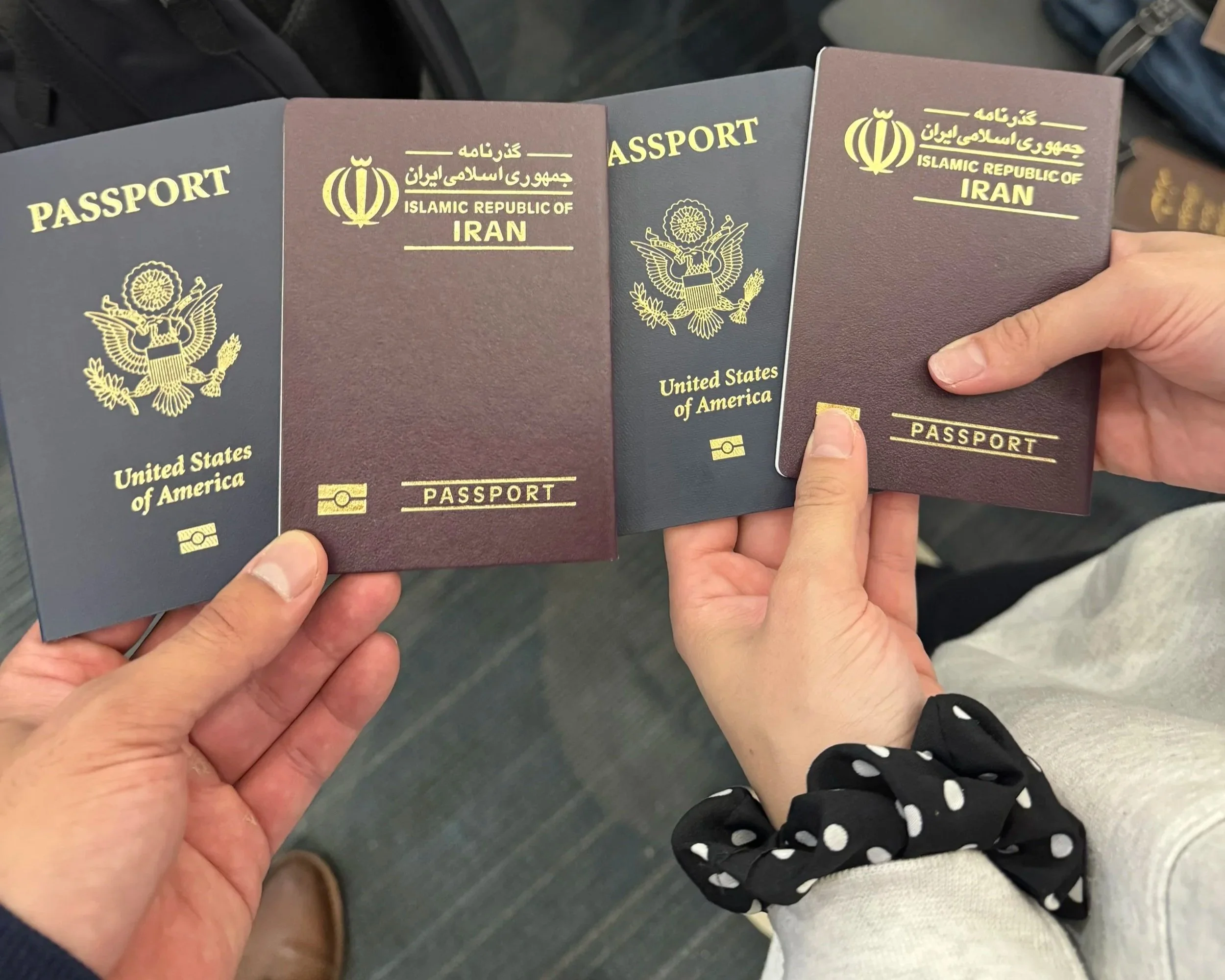
Us in Hartsfield filled with joy and excitement, for what we thought would be a successful trip to Iran…