I started tracking my daily habits during H2 of 2025. 8 months of habit tracking have passed and it has been a fun ride checking boxes, tracking metrics, and capturing my daily highlights. My habits journal houses all the “data” and the data paints a picture of how I live on a daily, weekly, and even monthly basis. There is a lot to gain from such a simple daily observation and notation. I want to share some of those findings.
Off the rip let me just say I gained lots of inspiration from Peter McKinnon (YT link) in starting this exercise.
Why Do I Track?
So what is the point of all of this? It boils down to a few reasons.
Priorities — Choosing what I track throughout my day creates prioritization. Of the hundreds of things (e.g., activities, habits, metrics) that I can track, the prioritization forces me to align my interests and habits to my day-to-day routine. Instead of focusing on a wide breadth of things, the daily structure allows me to cast my net a bit narrower and focus on the things that provide the most value to me (i.e., growth, enjoyment, health).
Consistency and Discipline — “What’s measurable gets managed”. Firstly, this mantra was important when I was determining what habits to track. They need to be measurable — something that I can check the box against. If it is not trackable, then my way of determining if it is complete is arbitrary. Secondly and more importantly, having a set of habits and activities to track creates accountability and focus, which creates consistency. Consistency is something worthwhile we should all strive for in different facets of our life. And to remain consistent over the long term, discipline is required. While I am by no means the most disciplined, it is a trait I value greatly.
Enjoyable and Insightful — There is no deep explanation here. I just straight up find it fun. The tracking is fun. The challenge of it is fun. And the insights I gain are fun.
What Do I Track?
It is an obvious answer on the surface level: habits, duh. However, what exactly does that look like? It varies based on the habits and details you want to track, so the tracker’s structure is infinite. My journey focuses on tracking 4 categories, which I outline below. One other callout is that my habit tracker follows a monthly format. So each month I take two pages of a journal, and the left page captures my daily recap and theme for the month, and the right page tracks my habits and sleep.
Daily Recap — If my day had a title, it would be this. This is the highlight of my day. It is summary-level so that means only a single line. Nothing more. While sometimes I list 2-3 things within that line, the highlight typically forces me to reflect on what was either the most prominent or memorable aspect of my day. It can be positive or negative, and this is important because not every day is roses and rainbows, so capturing the highlight (lowlight) of a crappy day is completely fine. Sometimes my days were mundane so there was no significant highlight. And that is also fine. However, one major benefit of the daily recap is it forces reflection. In a world where we are inundated with one piece of content after another — whether that be via social media, smartphones, or more traditional news — reflection is ever more valuable. The daily recap forces a pause on time to look backwards and perform an exercise that requires minimal effort but provides tremendous value. Reflect on what went well, what went poorly, what was fun, what you did not enjoy, what you learned, what you want to repeat, what you want to change, a moment of nostalgia, a moment of learning. The list can go on but the key is: a bit of daily reflection goes a long way.
Habits — This is what I find the most fun: the capture of actual habits and activities in my day-to-day. Marking an ‘X’ on the boxes I complete versus leaving the boxes for the habits that did not occur turns into a game. I felt excitement when I went through a day and was able to check all the boxes (i.e., each habit occurred or was completed). So what exactly did I track?
Outside: Getting outside for at least 20 minutes per day. It took the take the shape of commuting, walking to get groceries, sitting outside to catch golden hour, exercising, going for a casual post-lunch stroll. There were many more ways I checked the box, and beyond that the options to get outside are endless. However, the key is that it can be as casual or as intense as you want it to be. All that matters is getting outside. And why I find that important is because of the amount of time I typically spends indoors (e.g., wfh, sleep, Netflix and chill, working in an office, etc.) and how it makes me feel cooped up. Getting outside is a nice release and some fresh air (and sunlight if I am lucky to catch a nice day) does wonders to my mind, body, and soul.
Workout: Exercise is the ultimate release for me, and I like to rotate between running, tennis, and weight lifting. There are other exercises I enjoy — hiking, swimming, hooping, boxing, jump rope — but partake in much less often. The science is endless on why exercise is incredibly beneficial to our health. I recommend Peter Attia’s book Outlive (link — no, I don’t get paid for this lol) for some insightful metrics on exercise and its effects on healthspan. Aside from all the health benefits, I also find working out or playing sports very fun. (maybe you can equate having fun to better mental health, which I guess would tie everything back to some form of health)
Reading: It feels like reading a book is a lost art (hobby) nowadays. However, nostalgia is not the driver for reading. It is an aim for me to learn something new each day. With the inundation of short form content, less of what I take in has depth. Depth is good. So I find reading — whether that be a book, magazine, online news article, or novel — to be the antidote to a lack of depth. In many cases it allows me to go beyond a surface level of understanding and properly absorb content (i.e., not jumping from one TiK Tok / Reel / Short every 30 seconds). Now do not get it twisted, I still consume plenty of short form content. So I am not some role model who does not touch social media, but I can say without hesitation that I always feel better after consuming long form content than short form content.
Writing: I am very inconsistent with this habit, but writing — whether that be field notes, a gratitude journal, an ideas journal, a blog, taking notes, a letter — is the perfect solution to decluttering my brain and expressing myself. Writing is also the trustworthy companion I can always count on. Whenever I am solo and feel the need to express myself, I can easily grab some pen and paper (or my phone) to jot down whatever is in my head.
Water: Hydration is good. Drink water. I will spare you the endless reasons of why water is so beneficial for our bodies, but I aim for at least 100oz a day — ideally a gallon.
No Sweets: Having the biggest sweet tooth definitely does not help. I love sugar. In an imaginary world where there are no side effects to a poor diet, then I would easily be downing a pint of Ben & Jerry’s every single day. Anyways, the science is shocking in terms of how bad added and artificial sugars are. Dr. David Kessler, a pediatrician and former commissioner of the FDA who faced the tobacco industry head on in the 90’s, provides a summary of the negative side effects of sugar and ultraprocessed foods in this 60 minutes piece (link). It should be telling that someone who focused so heavily on combatting tobacco is now raising the alarm on ultraprocessed foods, which often contain great deals of artificial sugars like high fructose corn syrup. As much as my break up from sugar pains my soul, I know it is necessary for my healthspan. I now satisfy my sweet tooth by consuming more natural sugars via fruits and honey…and the occasional ice cream or dessert at a restaurant;) (Ooooo how I could crush some bread pudding right about now, but I digress…)
No Money Spent: Spending money is very fun. Getting the receipt or paying my credit card is not. So I aim to spend less than $10 a day. Despite being frugal, this habit is surprisingly the one I find the most difficult to follow. Over the course of a month, I tend to average only ~5-7 days of successfully not spending more than $10. Good ole capitalism and all the temptations that come with it lol. Anyways, this mindset of aiming to save more than you spend can benefit everyone.
Sleep — Honestly, while I do find it beneficial to track my sleep, half the reason I monitor it is because of the aesthetic variety and visual balance it brings to my tracker lol. The line graph adds a pop to the page and does a good job complimenting the mundaneness of the Xs and the text. Aside from that pointless reason, sleep is critical to our bodies and is often neglected by most of us. I aim for 7-8 hours of sleep per night. Matthew Walker, a professor of neuroscience and psychology at UC Berkley, paints a great picture of just how important sleep is in his book Why We Sleep (link — again, not an affiliate link).
Theme — this is a 1 liner of the overarching objective for the month. With all the distractions in life, the monthly theme reduces the chances of me wandering aimlessly. I find that with anything I want to accomplish, I benefit when there is a clearly defined vision / mission / end destination from the get go.
Themes from My Tracking
My sleep tends to go to s*** when traveling. No surprises here. However, outside of that my sleep is fairly consistent.
On average my habits are more inconsistent on the weekends. I believe that is due to me being less routine-based on the weekend since I am partaking in more activities. As a result, I sometimes prioritize those weekend activities over working out, getting outside, reading, and writing.
As mentioned above, spending less than $10 a day is a challenge. Even if I stay inside for most of the day and I also cook, the temptation of ecommerce is an easy way for me to click away my money.
Staying consistent with my habits requires discipline. Plain and simple.
When reviewing my Daily Recap, it was honestly shocking to see just how much I had done over 8 months. I immediately thought of Gates’s Law but at a much smaller scale. He says, “Most people overestimate what they can achieve in a year and underestimate what they can achieve in ten years.” In my scenario, I tend to overestimate what I can accomplish in a day or even a week, but over the course of multiple months, it is surprising how much I am able to get done. (not trying to brag, simply stating an observation)
What Does it Look Like?
See the images below for how I structure my habit tracker. Again, you can structure yours however you please. P.S. I blurred out certain details that are confidential or personal.
Conclusion
If you made it to the bottom, I appreciate you reading:) Now I challenge you to take one or two of the things I mentioned and adopt them into your daily practice.
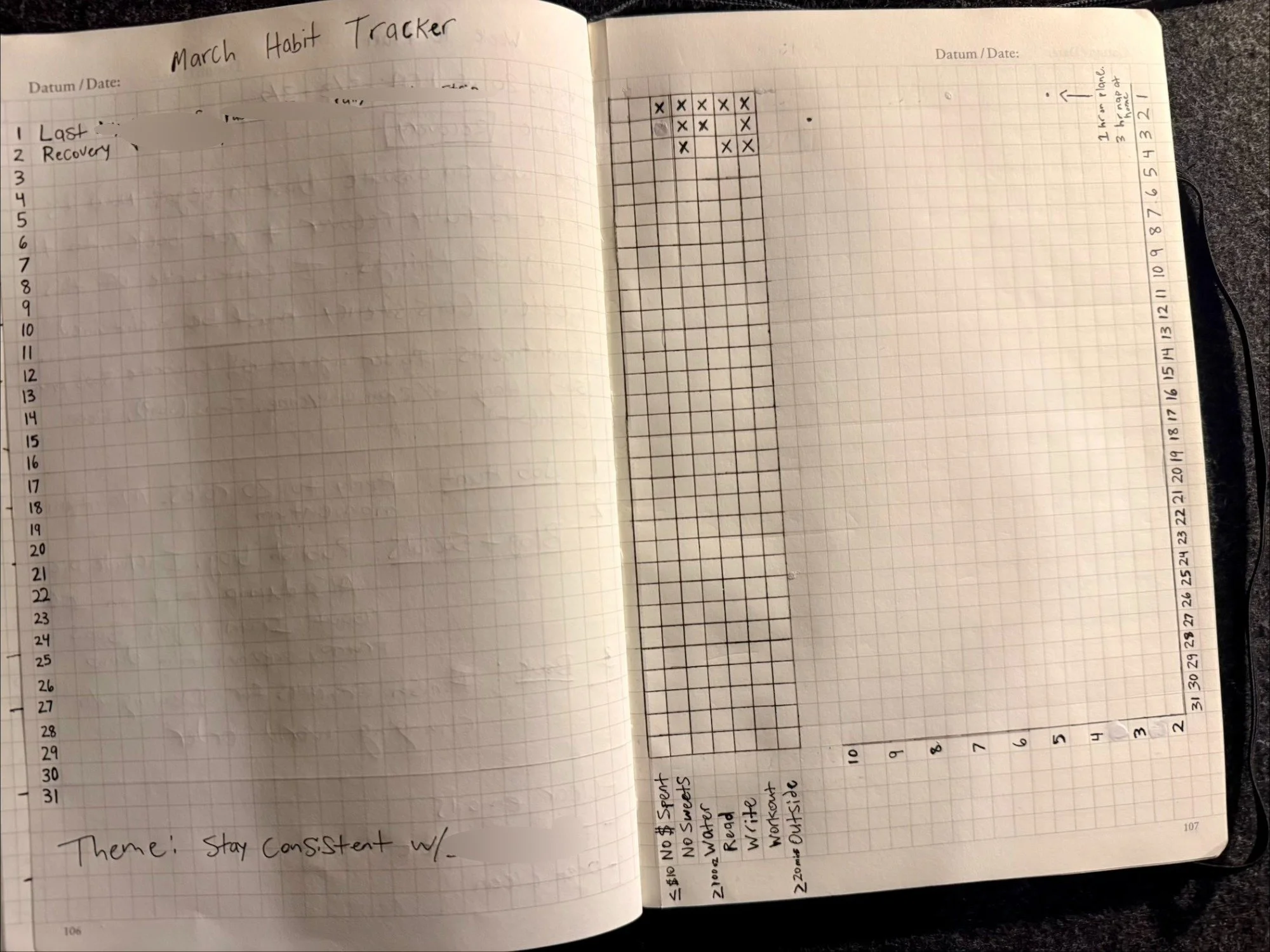
March 2026. The most recent month’s habit tracker. I include this one since it was the closest thing to a blank template I had. I was too lazy to mock up a full template since it requires a lot of ruler work ha.
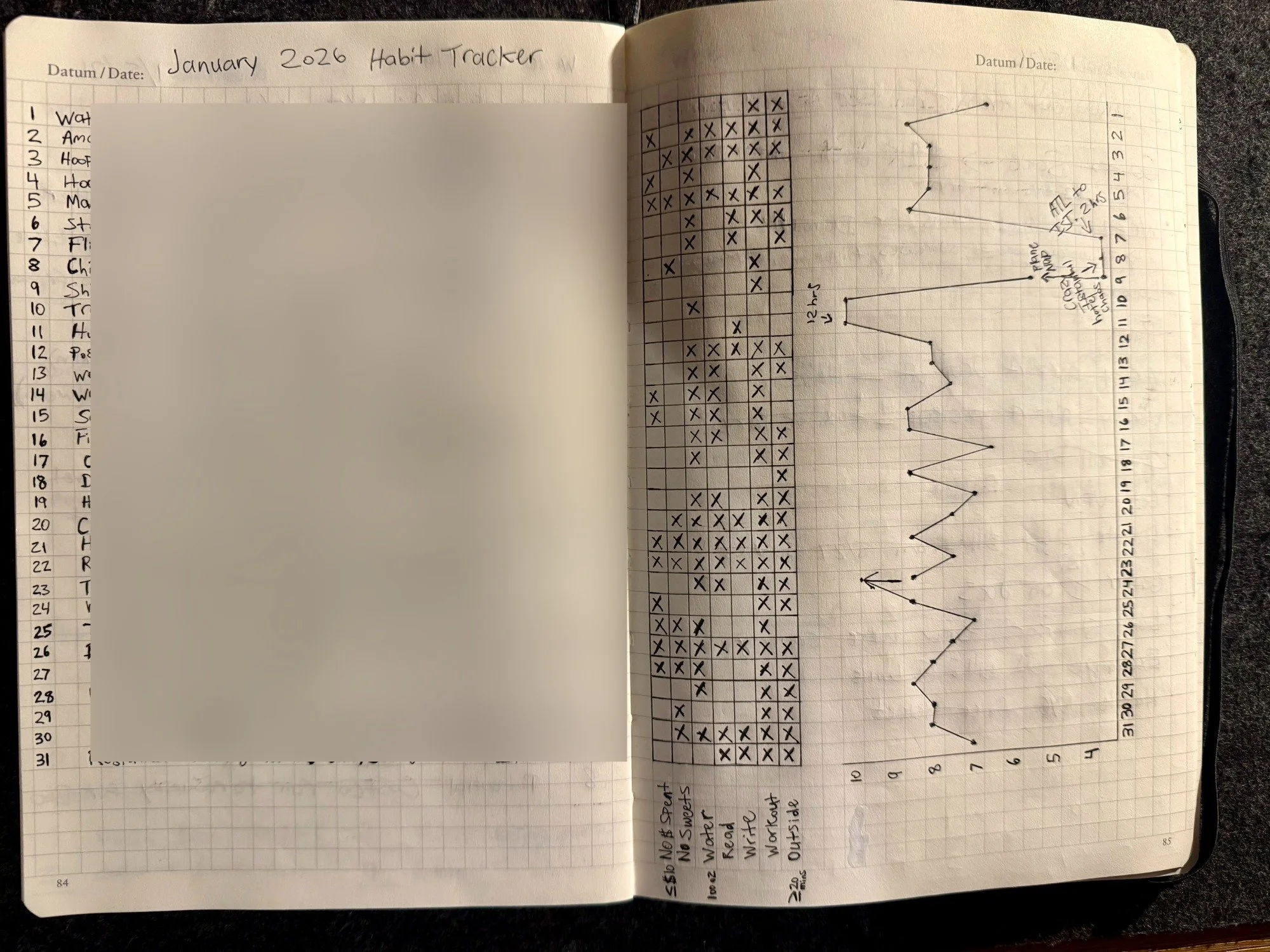
January 2026
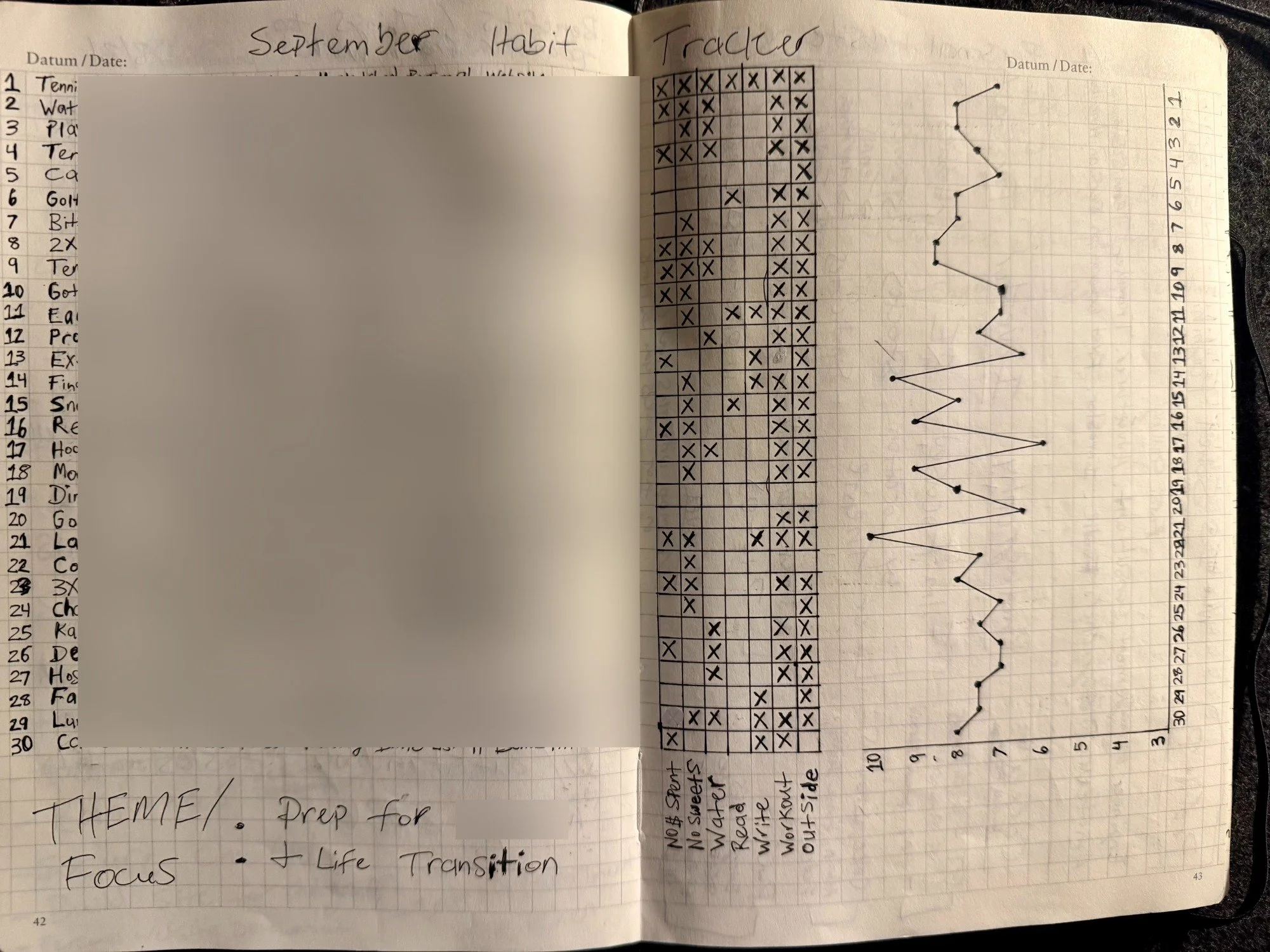
September 2025
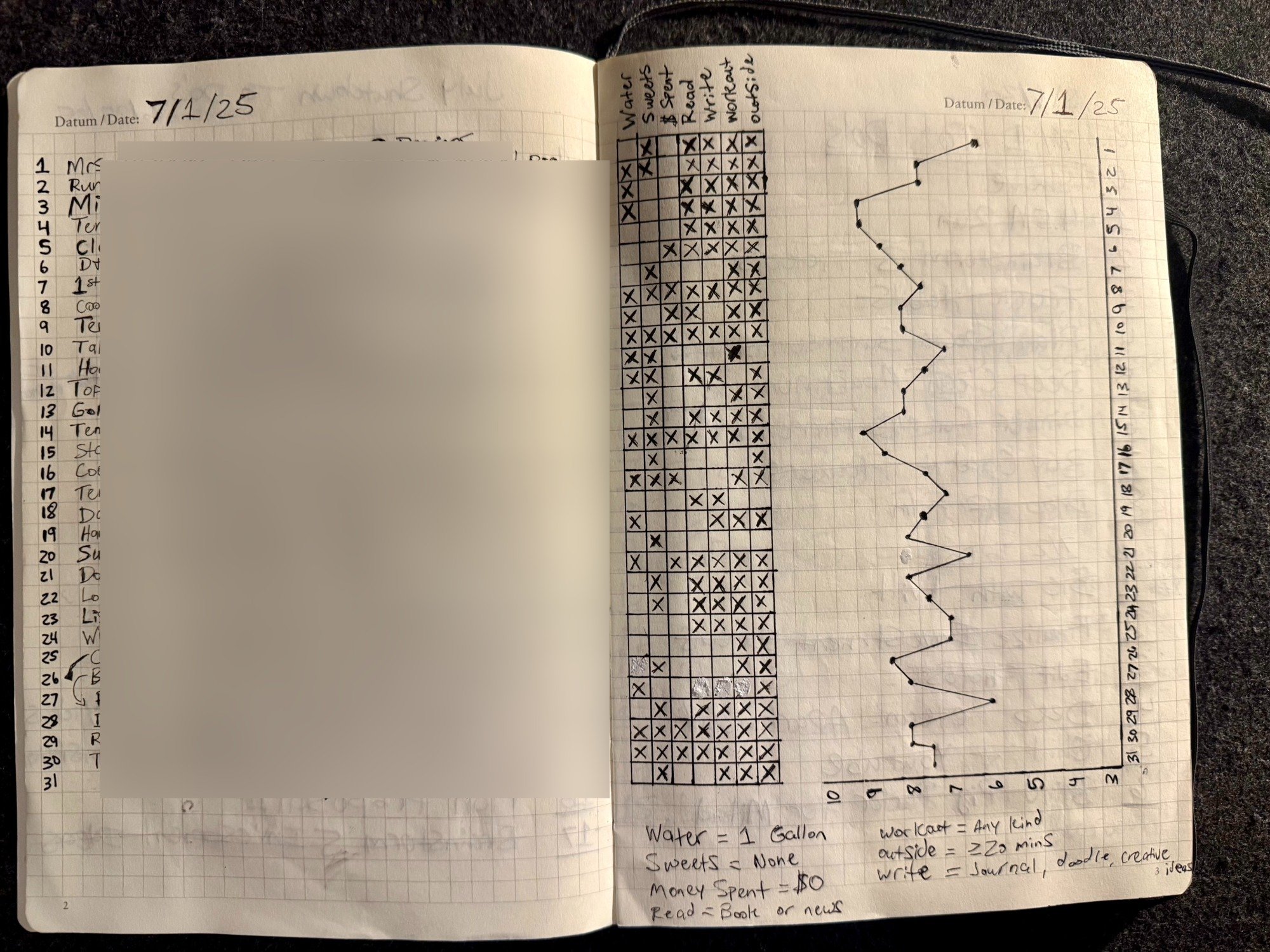
July 2025. My first month of habit tracking.